
How to Compare Residential Projects Beyond the Developer’s Brand Name
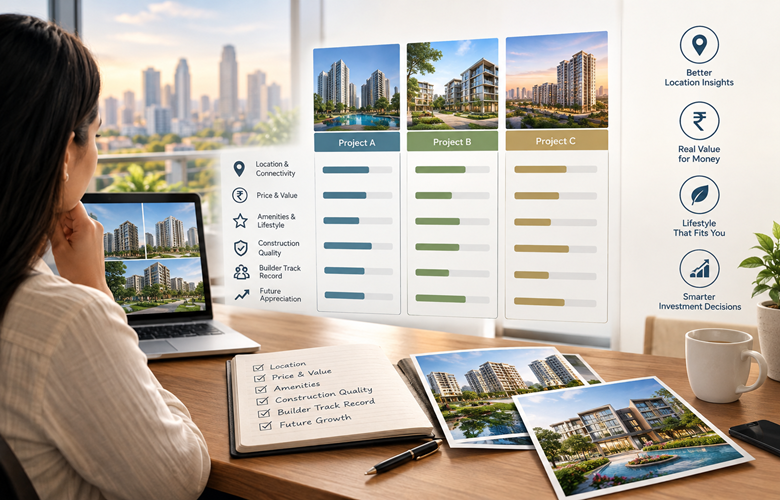
To compare residential projects beyond the developer’s brand, check 7 things: the promoter company on the RERA page, the registration number, carpet area, the full cost sheet, the payment schedule, the registered possession date and road access. A brand shows who is selling. These checks show what is sold, who is legally responsible and when delivery is due.
In this project, the brand is L&T Realty and the company that holds the land is International Green Scapes Ltd, a separate legal entity that L&T Realty Properties Ltd bought in full in April 2026.
That split is why a logo is a weak comparison tool. Each project gets its own RERA registration, and the registration page names the promoter company, the registration number with its date and the project status. The checks below read that page and the documents behind it, in the order a buyer can verify them.
How to Check RERA Registered Projects in Haryana
Open the Haryana RERA portal and search for the project. A registered project page shows the promoter’s company name, the date of registration and the current status. Match the promoter name to the company that owns the land and to the name printed on your agreement.
The RERA Act sets the rules on advertising. Section 11(2) requires every advertisement to show the Authority’s website address and the registration number, and Section 3(1) bars a promoter from advertising, booking, or selling a unit in a project that is not registered.
Section 4(2)(l)(D) requires 70 percent of the money collected from buyers to go into a separate project bank account, used for that project’s land and construction cost. Section 13 limits any advance to 10 percent of the apartment cost until a registered agreement for sale is signed.
For the L&T Sector 86 Gurgaon, the registration page is the first document to read once the number is published.
Carpet Area Vs Super Area Vs Built-Up Area
RERA carpet area is the net usable floor area of an apartment plus the area under its internal partition walls. It excludes external walls, an exclusive balcony or verandah, and an exclusive open terrace.
Built-up area adds wall thickness and balconies to the carpet area. Super area adds a share of common space such as lobbies, lifts, staircases and the clubhouse.
A rate per sq.ft. means nothing until the area type is named. Divide the total cost by carpet area to get the rate for usable floor, and use that single figure to compare 2 projects. For L&T apartments in Gurgaon, the 3 and 4 BHK sizes are still to be published, so this division waits for those sizes.
Extra Charges When Buying a Flat: Reading the Cost Sheet
A cost sheet is complete only when every charge is a separate line. Ask for these lines in writing:
- Base price per sq.ft.
- External development charges and infrastructure development charges
- Preferred location charges
- Parking
- Club membership
- Maintenance deposit
- Stamp duty and registration charges
- GST
External and infrastructure development charges are paid by the developer to the state government and passed on to the buyer, so they are part of your total even though the brochure rate does not show them.
A construction-linked plan ties each instalment to a construction stage. A time-linked plan sets fixed dates. The plan decides when your money leaves your account relative to what has been built.
Possession Delay Compensation Under RERA in Haryana
Section 18 of the RERA Act entitles a buyer to interest for every month of delay until possession is handed over. In Haryana, the prescribed rate is the SBI highest marginal cost of lending rate plus 2 percent.
A possession date is enforceable only when you can read it. Match the date in your agreement to the date on the registration page, and ask which date prevails if the 2 differ.
Because this is L&T Realty’s first NCR project, the possession date filed on the registration page is the delivery record to read.
Pre-Launch Projects in Gurgaon: What You Can Verify Before Launch
For the L&T Gurgaon Residential project, the pre-launch stage splits the 7 checks into 2 groups. You can verify some today from the developer’s announcements. The rest wait for the registration page.
Verifiable now
- Land: 20 acres in Sector 86, held by International Green Scapes Ltd, bought in full for ₹1,123 Cr
- Scale: about 3.6 million sq.ft. of development potential, which is about 180,000 sq.ft. per acre
- Location: the junction of NH-48, the Dwarka Expressway, and the Southern Peripheral Road
- Home types: 3 and 4 BHK apartments
Verifiable at registration
- Promoter company name
- Registration number and date
- Carpet area of each unit type
- Total cost sheet and payment schedule
- Registered possession date
Sector 86 Gurgaon Location and Road Access
Sector 86 is at the junction of NH-48, the Dwarka Expressway and the Southern Peripheral Road. Time the drive to your workplace in minutes at 9 am and again at 6 pm, because distance in kilometres hides peak-hour delays.
The project website lists the schools, hospitals, and offices near L&T Luxury Apartments Gurgaon are on the project website. Drive each route once before you shortlist.
What a Live HRERA Project Page Showed Us in Sector 86
While preparing this guide, we opened a live registered project page in Sector 86 on the Haryana RERA portal. The promoter field named a company, not a consumer brand. The number was dated, and the status line said the certificate was uploaded.
That is the pattern to look for on any project you compare: company name, number, date and status on a single screen. Our review order follows: promoter company first, registration number second, carpet area third, cost sheet fourth, and brochure last. The brochure is the only item on that list written by the seller.
A logo is a promise made in advertising. A promoter name on the registration page is a duty recorded with the regulator.
How to Choose Between Housing Projects
Treat the first 2 checks, the promoter match and the registration number, as pass or fail. A project that fails either is out, whatever the brand.
Score the other 5 checks on the numbers: the lower rate per sq.ft. of carpet area, the clearer cost sheet, the payment plan that follows construction, the earlier filed possession date, and the shorter peak-hour drive.
To follow registration, unit size and price updates for L&T Sector 86 Gurgaon Residential Projects.
Read more blogs: https://www.lntsector86gurgaon.com/blog
FAQs
How do you compare 2 residential projects from the same developer?
You compare their separate RERA registration pages, because each project has its own registration. Check the promoter company, registration number, possession date, carpet area, and total cost sheet side by side. Treat the promoter match and the registration number as pass or fail, then pick the lower rate per sq.ft. of carpet area.
What does RERA approved mean?
RERA approved is an advertising phrase, not a term the RERA Act uses. The Act requires registration under Section 3, so ask for the registration number and review the project page on the Haryana RERA portal. The page shows the promoter name, the registration number with its date, and the project status.
Can a builder take booking money before RERA registration?
No. Section 3(1) of the RERA Act bars a promoter from advertising, marketing, booking or selling a unit in a real estate project until the project is registered. Section 11(2) also requires every advertisement to show the registration number. If no number is shown, you should not pay any booking amount.
Does a developer need a new RERA registration for every project?
Yes. Section 3 requires registration of each real estate project, so every project has its own registration number, promoter page and possession date. A developer’s earlier registration does not cover a new project. You should read the registration page of the exact project you plan to buy in, not a sister project.
How long is a builder liable for structural defects?
A builder is liable for 5 years from the date you receive possession. If you report a structural defect in that period, Section 14(3) requires the promoter to fix it within 30 days of notice, at no charge to you. Keep the handover letter and dated photographs of the defect as proof.
When must you take possession after the occupancy certificate?
Section 19(10) of the RERA Act requires you to take physical possession within 2 months of the occupancy certificate. Check the certificate date before you accept keys, and read it against the date filed with the regulator. If the builder misses the filed date, interest applies for each month of delay under Section 18.
What is the L&T project in Sector 86 Gurgaon?
It is L&T Realty’s first NCR project, planned on a 20-acre parcel at the junction of NH-48, the Dwarka Expressway and the Southern Peripheral Road. L&T describes it as a luxury residential project with 3 and 4 BHK apartments. Price, unit sizes and the RERA number are still to be announced. You can register your interest for updates.
Which charges should a flat cost sheet list?
A flat cost sheet should list the base price, external and infrastructure development charges, preferred location charges, parking, club membership, maintenance deposit, stamp duty, registration charges and GST as separate lines. Add them to get the total cost, then divide by carpet area to compare projects on a single rate.
