
Construction Linked Payment Plan in 2026: Stages, Home Loan EMI, GST and TDS Explained
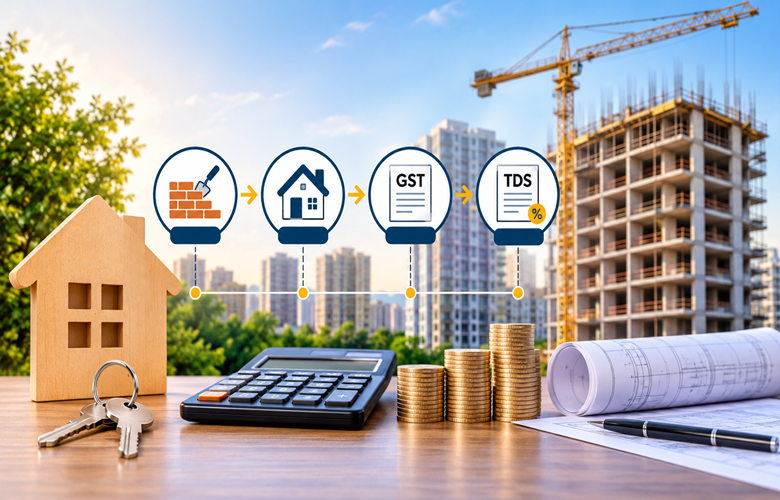
A construction linked payment plan (CLP) is a way of buying an under-construction home in which you pay the price in instalments that become payable only when the builder completes agreed stages of work, such as the foundation, each floor slab and the internal finish. Under the Real Estate (Regulation and Development) Act, 2016, a builder cannot collect more than 10 percent of the cost before a registered agreement for sale. On a non-affordable home in 2026, every stage payment attracts 5 percent GST and 1 percent TDS, and a home loan tranche can fund it.
Construction Linked Plan Example: Stages in a Builder Schedule
The payment annexure of your agreement for sale lists each stage and the share of the price attached to it. When a stage is complete, the builder sends a demand letter, and you pay within the period the agreement sets. A high-rise schedule usually follows this order:
- Booking amount at application
- Payment on registration of the agreement for sale
- Excavation and foundation
- Plinth or basement roof
- Floor slabs, often grouped in sets of floors
- Brickwork, plaster and flooring inside the apartment
- Offer of possession after the occupation certificate
RERA Rules for Builder Payment Demands
Section 4(2)(l)(D) of the RERA Act makes the builder deposit 70 percent of the money collected from buyers into a separate bank account. Withdrawals from it are allowed only in proportion to the work completed, and each one needs a certificate from an engineer, an architect and a chartered accountant in practice.
Section 11 adds a second record. The builder must update the project’s page on the state RERA website every quarter with bookings, approvals and construction status. A stage demand that is not backed by a certified withdrawal or the latest quarterly update deserves a written question before you pay.
Construction Linked Plan Home Loan: Pre EMI vs Full EMI
Banks release a loan for an under-construction flat in tranches that follow the builder’s demands, usually after their technical team checks the site. With pre EMI, you pay only interest on the amount disbursed so far, and principal repayment starts after the final tranche. With full EMI, repayment of principal begins from the first disbursement, which raises your early outgo but cuts the total interest over the loan.
The cost of that interest moved in October 2026, when the Reserve Bank of India raised the repo rate by 25 basis points to 5.50 percent and changed its stance to calibrated tightening, with rate cuts ruled out for the near term. If a lender passes the full hike on to a repo-linked loan, every ₹1 Cr already disbursed costs about ₹2,083 more in interest each month.
Prepaying during construction is now free on most home loans. From 1 January 2026, lenders cannot levy prepayment charges on floating-rate loans taken by individuals for non-business purposes, so any surplus can go straight into reducing the disbursed balance.
Pre-Construction Interest Deduction Under the Income-tax Act, 2025
Budget 2026 clarified that interest paid while the home is being built remains deductible under the new Act, which came into force on 1 April 2026. Section 22(1)(c) spreads that interest over 5 equal instalments, starting in the tax year the home is acquired or completed, so nothing is claimable while the tower is still rising.
The ₹2 lakh yearly cap for a self-occupied home comes with a condition. Construction must be complete within 5 years from the end of the tax year in which you borrowed. If it is not, the cap drops to ₹30,000. On long build cycles, the date of your first loan disbursement can decide which cap you get.
TDS and GST on Under Construction Property Instalments
From 1 April 2026, Section 393(1) of the Income-tax Act, 2025 replaced Section 194-IA, and Form 141 replaced Form 26QB. The deduction applies when the property value is ₹50 lakh or more, is worked out on the higher of the sale price and the stamp duty value, and is made on each instalment rather than once.
GST applies only to instalments paid before the occupation or completion certificate, and payments made after it are outside GST. The GST overhaul of September 2025 did not change residential rates, and affordable homes stay at 1 percent.
On a ₹60 lakh slab, demand for a non-affordable flat: ₹3 lakh of GST is added, you deduct ₹60,000 as TDS and deposit it with the tax department, and the builder receives the rest.
CLP vs PLP vs Down Payment Plan
A possession-linked plan (PLP) keeps a large share of the price for handover. A down payment plan collects most of the price early, usually in return for a discount. A stage-wise plan is in between: your outgoings follow visible progress and less money is exposed if work stalls. The trade-offs are that you usually pay the full list price, a rising rate cycle lifts your pre-EMI, and rent and pre-EMI overlap if you live elsewhere during construction.
The 2026 market gives buyers room to ask for better terms. NCR housing sales fell 11 percent in January to September 2026 to 35,574 units, and Gurugram held 57 percent of the region’s unsold homes. In the ₹5 Cr to ₹10 Cr band, 2,346 homes were launched in July to September against 925 sold. Gurugram prices still rose 4 percent over the year, so the room to negotiate lies in the schedule more than in the price.
Subvention Scheme vs. Construction-Linked Plan
Under a subvention scheme, the bank paid the sanctioned loan straight to the builder, and the builder agreed to pay the EMIs until handover. When builders defaulted, banks turned to buyers for repayment under the tripartite agreement.
On 20 January 2026, the Supreme Court asked a special CBI court in Delhi to take cognisance of 3 charge sheets on the builder-bank nexus within 2 weeks, and asked 23 banks and financial institutions to deposit ₹10 lakhs each into a special account. Gurugram is among the NCR areas where the court found a prima facie nexus.
In a stage-wise plan, each tranche is released against a disbursal request you sign, so you know each time part of the loan moves to the builder.
Possession Delay Compensation Under RERA in Gurugram
If the builder misses the possession date in your agreement, Section 18 of the RERA Act lets you either withdraw with a refund plus interest, or stay in the project and receive interest for every month of delay until possession. In Haryana, the rate is the State Bank of India’s highest marginal cost of lending rate plus 2 percent.
A September 2026 order of the Gurugram regulator fixed this at 10.80 percent a year for 26 buyers of a delayed affordable project in Sector 108, calculated on the amount each buyer had paid rather than the full price. At that rate, a buyer who has paid ₹1.5 Cr receives about ₹1.35 lakh for each month of delay.
How to Check a Builder Demand Letter Before Paying?
We read the payment annexure before the brochure. The first thing we look for is a stage that is really a date in disguise, such as an amount due 6 months from booking, because that turns part of the plan into a time-linked one. Next, we compare how much is due by the time the top slab is cast against how much is left for finishing and possession. A schedule that collects most of the price by the top slab leaves little with the buyer for the slowest part of any build: interiors, services and the occupation certificate.
For every demand, we ask buyers to keep the demand letter, the architect’s progress certificate and the bank’s disbursal record together. If they disagree on the stage, raise it in writing before paying. Our guide to documents to check before buying a flat covers the paperwork that comes before the first demand.
“Pay for concrete you can see, not for a date on a calendar.”
New Launch Payment Planning in Sector 86 Gurgaon
The September 2032 possession date listed for L&T Aravista Sector 86 Gurgaon turns these rules into real numbers. Phase 1 of this L&T Realty Gurgaon project has 3 of the 7 planned towers at G+37 with about 400 homes, and 3 BHK homes start at ₹4.5 Cr, indicative and excluding taxes and statutory charges.
At that starting price, the legal ceiling before a registered agreement is ₹45 lakhs, GST can add up to about ₹22.5 lakh if every instalment is paid before the completion certificate, and TDS over the full schedule totals ₹4.5 lakh. The tax timing matters too: a buyer whose first loan disbursement comes before 1 April 2027 would need the home completed by 31 March 2032 to keep the higher interest cap, which is earlier than the listed possession date. The project page states that RERA registration has been applied for and advises checking the Haryana RERA portal before paying any booking amount.
Anyone making an L&T Aravista comparison with other launches near Dwarka Expressway, about 10 minutes from the site by car, should set the payment annexures side by side. For Dwarka Expressway property investment with a 6-year build, the schedule decides how long your money is locked in before possession. Our note on Sector 86 infrastructure in 2026 covers the road and civic progress a long build depends on.
Luxury Apartments Investment in Gurgaon: Cash You Need Outside the Loan
For loans above ₹75 lakhs, banks can fund at most 75 percent of the property value, so at least a quarter of the price comes from your own money. For any home costing more than ₹10 lakhs, banks cannot add stamp duty and registration charges to the cost when working out that limit, so you must also arrange those charges. For luxury apartment investment in Gurgaon, this own-funds share, not the loan, usually sets the pace of a stage-wise plan.
Configurations, the starting price and the RERA status of L&T Aravista are updated on the project page at Experion Emerelle Reserve, the place to begin when planning an L&T Aravista investment.
FAQs
Is the booking amount refundable if I cancel a flat booking?
Only partly. If you withdraw without any fault on the builder’s side, the Gurugram regulator’s 2018 forfeiture regulations let the builder keep no more than 10 percent of the consideration as earnest money, and the rest must be refunded. Read the cancellation clause before booking, because the deduction is calculated on the total price, not on what you have paid.
What happens if I pay a construction-linked instalment late?
You pay interest on the overdue amount at the same rate the builder would owe you for a default, because Section 2(za) of the RERA Act sets one equal rate for both sides. Repeated defaults can also trigger the cancellation clause in your agreement for sale, so check the notice period and default terms before you sign.
Can NRIs pay construction-linked instalments from abroad?
Yes. NRIs can pay through inward remittance via normal banking channels or from NRE, FCNR or NRO accounts held in India. Payment in foreign currency notes or traveller’s cheques is not allowed. Keep the bank advice for every instalment, because these records support repatriation of the money when you later sell the home.
Can the builder change the payment schedule after the agreement is signed?
Not on its own. The payment schedule is part of the registered agreement for sale, which binds both parties, so any change to amounts or stages needs your written consent. If a demand does not match the annexed schedule, reply in writing and ask the builder to state the clause it relies on before you pay.
Can a builder extend the possession date of a RERA project?
Not on its own. Under Section 6 of the RERA Act, the regulator can extend a project’s registration on the builder’s application in cases of force majeure, and the extension cannot exceed 1 year in total. Check the project page on the state RERA website for any extension order before you pay each new stage demand.
How is TDS deducted when 2 people buy a flat together?
Each buyer deducts TDS on their own share of every payment and files a separate statement using their own PAN. The threshold is checked against the total property value, not each buyer’s share, so co-buyers of an ₹80 lakh flat must both deduct TDS even though each share is ₹40 lakhs.
How much stamp duty do you pay on a flat in Gurgaon?
In urban Haryana, including Gurgaon, stamp duty is 7 percent for men, 5 percent for women and 6 percent for joint ownership. You pay it when the conveyance deed is registered, usually after the occupation certificate, and not with the construction instalments, so keep this amount ready alongside your final payment.
